


WHAT IS GST?
GST i.e.Goods and Service Tax is a unified tax that replaces several indirect taxesleviedby the Central Government and the State Government(s)....
Read more
06/2011-Cus, Dated: 18/01/2011
Regarding norms for execution of Bank Guarantee in respect of Advance Authorization / Duty Free Import Authorization (DFIA) / Export Promotion Capital Goods (EPCG) Schemes
Circular No. 06 /2011-Customs F.NO.609/119/2010-DBK Department of Revenue Government of India Ministry of Finance New Delhi, the 18th January, 2011 To,All Chief Commissioners of Customs / Customs & Central Excise. All Directors General of CBEC /CDR, CESTAT. All Commissioners of Customs & Central Excise. Sir/Madam, Sub: Norms for Execution of Bank Guarantee in respect of Advance Authorization / Duty Free Import Authorization (DFIA) / Export Promotion Capital Goods(EPCG) Schemes– reg. The undersigned is directed to invite your attention to Circular No.58/2004-Cus. dt. 21.10.2004 on the above subject as amended by Circular Nos.17/2009-Cus. dt. 25.5.2009 and 32/2009-Cus. dt. 25.11.2009 and to state that references have been received with reference to para 3.2(c) of the Circular No. 58/2004-Cus. dt.21.10.2004. Para 3.2(c) of the said Circular, inter alia, stipulates that exemption from Bank Guarantee contemplated therein will not be available in case the licence holder has been penalized under the provisions of Customs Act, 1962, the Central Excise Act, 1944, the Foreign Exchange Management Act (FEMA), 1999 or the Foreign Trade (Development and Regulation) Act, 1992 during the previous three Financial years. 2. It has been informed that many a time requests are received from importers for exemption from Bank Guarantee on the ground that penalty imposed on them was on account of offences which were technical in nature. It has been suggested that exemption from Bank Guarantee may not be denied in cases of technical offences. 3. The issue has been examined. It is noted that the Board has recently relaxed the criteria for accreditation of importers under the Accredited Clients Programme (ACP) vide circular No.29/2010-Cus. dt. 20.8.2010.According to the said circular, the importer for availing the facility under ACP should not have any cases of Customs, Central Excise or Service Tax, as detailed below, booked against them, in the previous three financial years: (a) Cases of duty evasion involving mis-declaration / mis-statement/collusion / willful suppression / fraudulent intent whether or not extended period for issue of Show Cause Notice (SCN) has been invoked. (b) Cases of mis-declaration and/or clandestine/unauthorized removal of excisable / import / export goods warranting confiscation of said goods. (c) Cases of mis-declaration / mis-statement / collusion / willful suppression / fraudulent intent aimed at availing CENVAT credit, rebate, refund, drawback, benefits under export promotion/reward schemes. (d) Cases wherein Customs/Excise duties and Service Tax has been collected but not deposited with the exchequer. (e) Cases of non-registration with the Department with intent to evade payment of duty / tax. 4. It has been decided that the above criteria may be adopted and para 3.2( c) of Circular No. 58/2004-Cus modified to this extent. Thus offences, other than those stipulated at para 3 above, would not result in denial of the benefit of Circular No.58/2004-Cus. In order to verify whether the Authorization holder meets the above criteria, he may be asked to furnish an affidavit stating whether any case(s) involving mis-declaration, suppression etc. as mentioned in para 3 above have been booked against him during the previous three Financial years under the provisions of the Custom Act,1962,Central Excise Act,1944, the Foreign Exchange Management Act (FEMA), 1999, the Foreign Trade (Development and Regulation) Act,1992 and the Service Tax (Finance Act,1994).In case the details reveal violation(s) of the type mentioned above under the provisions of the above mentioned Acts then the benefit of Circular No. 58/2004-Cus.will not be extended. The Commissioners shall ensure that some of the affidavits furnished are cross checked randomly with the field formations for their veracity. 5. These instructions may be brought to the notice of the trade / exporters by issuing suitable Trade / Public Notices. Suitable Standing orders/instructions may be issued for the guidance of the assessing officers. Difficulties faced, if any, in implementation of the Circular may please be brought to the notice of the Board at an early date. Receipt of this Circular may kindly be acknowledged. Yours faithfully, |
GST i.e.Goods and Service Tax is a unified tax that replaces several indirect taxesleviedby the Central Government and the State Government(s)....
Read more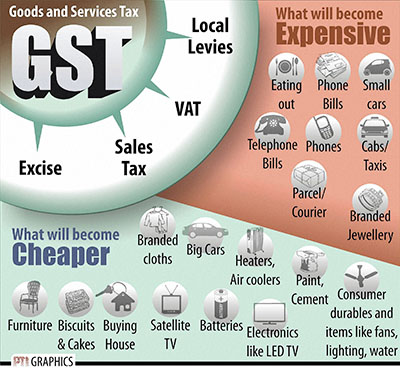
In pre-GST regime, goodswere liable to: (i) Excise Duty- on manufacture of goods; (ii) VAT/CST- on sale of goods; (iii) Entry tax- on ...
Read more
GST is levied on every taxable person. Taxable person means a person who carries on any business at any place in India. Such . ..
Read more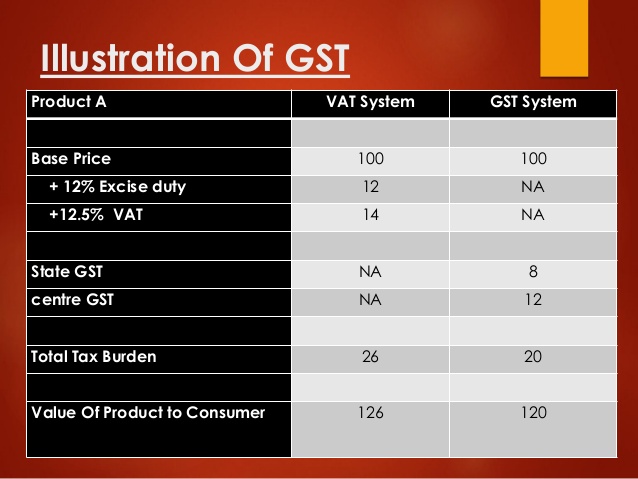
GST is a unified tax which is levied on: (i) goods; (ii) services and (iii) a mix of goods and/or services. Any supply of goods or services . .. ...
Read moreGST India Solution is an effort of firm of professionals who welcome implementation of GST. This is an interactiveplatformthat aspires to disseminate right knowledge to professionals, practitioners and public at large. This platform has beenfloatedbya firm of Chartered Accountants relentlessly working in field of direct and indirect taxes since early 1985.
READ MORE
Our core competence is statutory compliance, advisory, corporate tax planning and appellate matters of direct and indirect taxesandcorporate training sessions on GST.
The senior partner of the firm has to his credit several professional publications viz., Delhi Sales Tax Right to Use Goods Act, Delhi VAT, Maharashtra VAT, West Bengal VAT, Haryana VAT published by Taxmann. Madhya Pradesh VAT and Chhattisgarh VAT were published by Suvidha Law House, Bhopal. He has also addressed seminars on indirect taxes organized by professional bodies like ICAI, IMA, NIFM etc. and has also contributed articles on subjects of pro. . . . .

From 9th January 2017, the GST enrollment for service tax assessee shall start and which needs to be completed within a month till 31st January 2017.
read more
The existing taxpayers will have to get themselves enrol / register / migrate under Goods and Services Tax (GST) System in the month of November itself.
read more
If you are an existing taxpayer registered under Excise, Service Tax and State Tax Laws such as VAT, Entry Tax, Luxury Tax and Entertainment Tax, then you will need to enroll for GST online.
read more
It is very important to understand the registration procedure under GST because even the existing dealer will also have to apply for the GST registration online.
read more
GST is now a reality, and it is knocking the doors. This article answers the most important question which is in every bodies mind that who all are liable to register under GST?
read more
This article explains the importance of service tax registration when GST is on the doorstep. Under GST, every person being a service provider, a dealer, trader, manufacturer, Exporter, Importer etc will have to apply for GST registration.
read more
This article explains the registration process under the new Goods and Service Tax (GST) Act, 2016. The whole process under GST regime is also online. The structure of GSTTIN is also explained in this article
read more
This articles describes the documents required for GST registration in India. The list of documents required for each form of business has been listed down separately for better clarity.
read more