WHAT IS GST?
GST i.e.Goods and Service Tax is a unified tax that replaces several indirect taxesleviedby the Central Government and the State Government(s)....
Read more
|
34AD. Removal from register of names of valuers and restoration. (1) The 60[Chief Commissioner or Director General] may remove the name of any person from the register of valuers where 61[he] is satisfied, after giving that person a reasonable opportunity of being heard and after such further inquiry, if any, as 61[he] thinks fit to make,—
(2) The 60[Chief Commissioner or Director General] may, on application and on sufficient cause being shown, restore to the register the name of any person removed therefrom.] 62[(3) Without prejudice to the provisions of sub-sections (1) and (2), the Chief Commissioner or Director General shall, once in three years review the performance of all the registered valuers and may remove the name of any person from the Register of Valuers where he is satisfied, after giving that person a reasonable opportunity of being heard and after such further inquiry, if any, as he thinks fit to make, that his performance is such that his name should not remain on the Register of Valuers. (4) The Chief Commissioner or Director General may himself conduct the inquiry referred to in sub-section (1) or sub-section (3) or appoint an Inquiry Officer not below the rank of a Commissioner to conduct such inquiry, and for the purposes of such inquiry, the Chief Commissioner or Director General and the Inquiry Officer so appointed shall have the same powers as are vested in a court under the Code of Civil Procedure, 1908 (5 of 1908 ), when trying a suit in respect of the following matters, namely:—
|
GST i.e.Goods and Service Tax is a unified tax that replaces several indirect taxesleviedby the Central Government and the State Government(s)....
Read more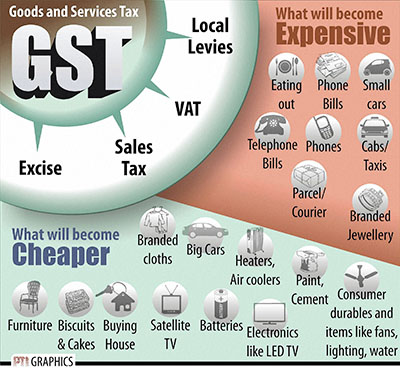
In pre-GST regime, goodswere liable to: (i) Excise Duty- on manufacture of goods; (ii) VAT/CST- on sale of goods; (iii) Entry tax- on ...
Read more
GST is levied on every taxable person. Taxable person means a person who carries on any business at any place in India. Such . ..
Read more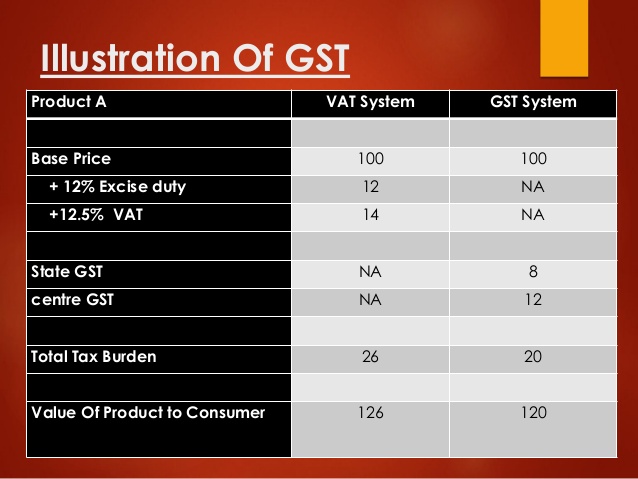
GST is a unified tax which is levied on: (i) goods; (ii) services and (iii) a mix of goods and/or services. Any supply of goods or services . .. ...
Read moreGST India Solution is an effort of firm of professionals who welcome implementation of GST. This is an interactiveplatformthat aspires to disseminate right knowledge to professionals, practitioners and public at large. This platform has beenfloatedbya firm of Chartered Accountants relentlessly working in field of direct and indirect taxes since early 1985.
READ MORE
Our core competence is statutory compliance, advisory, corporate tax planning and appellate matters of direct and indirect taxesandcorporate training sessions on GST.
The senior partner of the firm has to his credit several professional publications viz., Delhi Sales Tax Right to Use Goods Act, Delhi VAT, Maharashtra VAT, West Bengal VAT, Haryana VAT published by Taxmann. Madhya Pradesh VAT and Chhattisgarh VAT were published by Suvidha Law House, Bhopal. He has also addressed seminars on indirect taxes organized by professional bodies like ICAI, IMA, NIFM etc. and has also contributed articles on subjects of pro. . . . .
From 9th January 2017, the GST enrollment for service tax assessee shall start and which needs to be completed within a month till 31st January 2017.
read more
The existing taxpayers will have to get themselves enrol / register / migrate under Goods and Services Tax (GST) System in the month of November itself.
read more
If you are an existing taxpayer registered under Excise, Service Tax and State Tax Laws such as VAT, Entry Tax, Luxury Tax and Entertainment Tax, then you will need to enroll for GST online.
read more
It is very important to understand the registration procedure under GST because even the existing dealer will also have to apply for the GST registration online.
read more
GST is now a reality, and it is knocking the doors. This article answers the most important question which is in every bodies mind that who all are liable to register under GST?
read more
This article explains the importance of service tax registration when GST is on the doorstep. Under GST, every person being a service provider, a dealer, trader, manufacturer, Exporter, Importer etc will have to apply for GST registration.
read more
This article explains the registration process under the new Goods and Service Tax (GST) Act, 2016. The whole process under GST regime is also online. The structure of GSTTIN is also explained in this article
read more
This articles describes the documents required for GST registration in India. The list of documents required for each form of business has been listed down separately for better clarity.
read more